
The Cardboard Surgeon
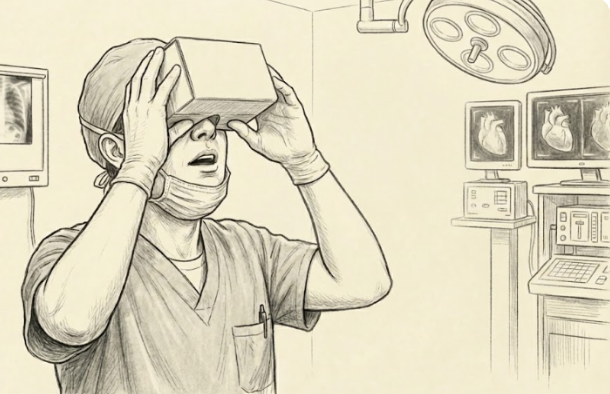
In 2014, Virtual Reality was mostly a toy. A rich person’s toy. If you wanted to step into the metaverse, you needed a powerful gaming computer, a mess of cables, and a headset that cost as much as a used car.
At the Google Cultural Institute in Paris, two engineers named David Coz and Damien Henry decided this needed to be fixed. They didn't want to make VR more powerful; they wanted to make it accessible. They wanted to bring it to classrooms in low-income neighborhoods and communities too often left behind. They didn't have a budget or a mandate from leadership, but they did have "20% Time.” Google’s policy that encourages employees to spend one day a week working on a project of their own choosing.
Fueled by their own curiosity, they ordered some cheap lenses and grabbed a nearby pizza box. They folded the cardboard, slotted in a smartphone, and created a VR headset that cost less than a sandwich.
They called it Google Cardboard.
To the tech world, it was a fun, low-fi novelty. But to a baby named Teegan Lexcen and her parents, it was a miracle. Teegan was born in Minnesota with only one lung and half a heart. Her condition was so rare and so complex that doctors deemed it inoperable. Desperate, her parents flew her to Nicklaus Children’s Hospital in Miami to see Dr. Redmond Burke. Dr. Burke knew he had to operate, but the 2D scans were insufficient. With the hospital’s 3D printer malfunctioning, he was handed a Google Cardboard by his colleague, Dr, Jaun Carlos Muniz.
He uploaded the scans to an app, slid his iPhone into the slot, and suddenly, he was standing inside the chest of the patient. He could look around. He could see the obstruction. He could map out a surgical path that would have been unrecognizable on a 2D xray.
The surgery was a success. Teegan lived.
David Coz and Damien Henry didn't set out to reinvent pediatric heart surgery. They just wanted to work on a project they truly cared about.
When we give people the freedom to follow their curiosity, we get the best out of our teams. And we might even save a life.