
The Man Who Jumped Backward
For millenia, people have jumped over things, and likely for millenia, they’ve done it competitively. At a bare minimum, the world has seen 200 years of competitive, international high jump competitions, with Adam Wilson setting a record for Great Britain in 1827.
From the Ancient Greeks to the athletes of the 1820s (in fact until the 1960s) the world’s greatest athletes approached the challenge the same way: feet first. The sport wasn’t without evolution and innovation, with jump techniques ranging from the straddle to the western roll to the scissor kick. But always, and forever, feet first. Head on. Attacking the problem the same way cavemen would have jumped over a stream two million years ago. Run at the obstacle and jump.
We developed new shoes, adopted new training regimens, and made tweaks to the jumping mechanics, but the underlying assumption never changed. Feet first was the final, unimprovable system for success.
Then came Dick Fosbury.
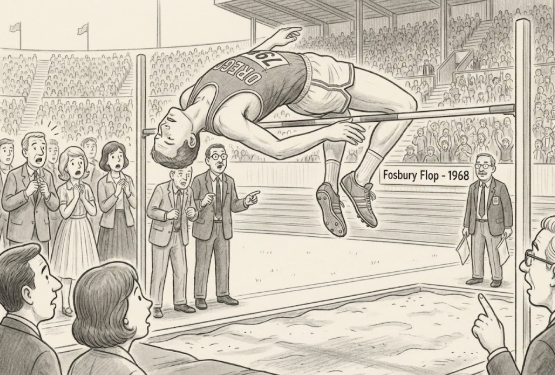
As a young Oregon college student in the late 1960s, Fosbury couldn't master the accepted straddle technique. Instead of quitting, he looked at the problem with fresh curiosity, experimenting with what felt natural. He began launching himself toward the bar, twisting his body mid-air, and sailing over on his back. His head and shoulders cleared the bar first, followed by the rest of his body in a wild, gravity-defying arch.
His coaches were shocked, spectators laughed, and officials were confused. They saw chaos and foolishness; Fosbury saw a massive opportunity that everyone else was too constrained to see.
The culmination of this defiance arrived at the 1968 Mexico City Olympics. The world watched as Fosbury soared over the bar, head first, winning the gold medal and setting a new Olympic record.
Dick Fosbury looked at the single element of the sport that had been deemed unequivocally and permanently correct, and changed it.
He changed the sport forever, not through a high tech feat of engineering or scientific discovery, but by simply jumping backward instead of forward. His single, absurd act of questioning the thing everyone else took for granted created the standard method used by every elite high jumper today. Innovation can be incredibly simple, but it may require the courage to disregard two thousand years of proof.